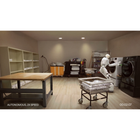
- Two 7-DOF Arms Seven degrees of freedom in each arm handle the reach and orientation that equipment and work surfaces demand.
- Four Steerable Wheels The base drives between stations on steerable wheels rather than walking, keeping the engineering budget in the upper body.
- Folding Lower Body The lower body folds to extend the range of working postures for low and elevated tasks.
- Whole-Body Control at 100 Hz A controller trained by reinforcement learning in simulation converts task-space targets into joint targets and wheel velocities a hundred times a second.
- Workflow Orchestrator A vision-language layer decides the next activity and keeps a text memory of observations such as machine state and item counts.
- Recovery Behaviour Retrying a grasp, correcting an interrupted operation and responding to a dropped object are treated as part of running a long workflow.
- Learning from Human Video A Unified Robot Representation expresses motion as task-space poses, so human recordings pre-train a policy that robot demonstrations then adapt.

Description
Taku is Dyna Robotics' wheeled semi-humanoid, introduced as the hardware for its Dyna-2.1 physical agent. Two seven-degree-of-freedom arms sit on a human-shaped upper body over a base with four steerable wheels, and a folding lower body extends the range of working postures for low and elevated tasks. The body is sized to approximate an average person, which is what makes human wrist, elbow and chest movement usable as training material.
The names describe different things and it is worth keeping them apart when specifying a system: Taku is the robot, Dyna-2.1 is the agent that runs it. The agent splits into three layers. A whole-body controller, trained by reinforcement learning in simulation, converts task-space targets into joint targets and wheel velocities at 100 Hz. A Dyna-2 action policy generates the trajectories for physical skills. A vision-language workflow orchestrator runs on a slower clock and decides what should happen next.
That separation is why Taku's demonstration workflow is a whole commercial laundry rather than a single trick. Taku works between washers, dryers, a folding table and storage shelves, and because machines finish at different times, folding sometimes has to pause while another station is serviced. The orchestrator tracks progress using a text memory of what it has observed - machine states, how many towels are folded - so it can choose the next activity when the evidence is no longer in front of the camera. Recovery from mistakes is treated as a requirement: retrying a grasp, correcting an interrupted operation, responding to a dropped object.
Training uses a Unified Robot Representation that expresses movement as task-space poses shared between human recordings and robot demonstrations, so human video can pre-train a policy that robot-specific data then adapts to this body. Dimensions, mass, payload, reach envelope, travel speed and runtime are confirmed before an order. Which procedures are supported, how performance is measured and what supervision is expected are the questions worth putting in writing.
Key Capabilities
- Two 7-DOF Arms: Seven degrees of freedom in each arm handle the reach and orientation that equipment and work surfaces demand.
- Four Steerable Wheels: The base drives between stations on steerable wheels rather than walking, keeping the engineering budget in the upper body.
- Folding Lower Body: The lower body folds to extend the range of working postures for low and elevated tasks.
- Whole-Body Control at 100 Hz: A controller trained by reinforcement learning in simulation converts task-space targets into joint targets and wheel velocities a hundred times a second.
- Workflow Orchestrator: A vision-language layer decides the next activity and keeps a text memory of observations such as machine state and item counts.
- Recovery Behaviour: Retrying a grasp, correcting an interrupted operation and responding to a dropped object are treated as part of running a long workflow.
- Learning from Human Video: A Unified Robot Representation expresses motion as task-space poses, so human recordings pre-train a policy that robot demonstrations then adapt.
This model is offered on a quotation basis. Configuration, accessories, integration scope and delivery schedule all change the final figure, so pricing is confirmed per project rather than listed.
Buying through Robotix Market
This unit is sourced new through established distribution channels and ships worldwide with the manufacturer warranty. Technical support is coordinated with the manufacturer's own service network. Deployment scope, configuration, and commissioning responsibilities are agreed as part of the quotation — on-site installation is not included in the product price.
Features
Specs
| Brand | DYNA |
|---|---|
| Manufacturer | Dyna Robotics |
| Model | Taku |
| Product Type | Wheeled semi-humanoid mobile manipulation robot |
| Arms | Two arms, 7 degrees of freedom each |
| Base | Four steerable wheels |
| Lower Body | Folding, for low and elevated working postures |
| Arm Actuators | Low-ratio planetary actuators |
| Agent | Dyna-2.1, comprising whole-body controller, Dyna-2 action policy and vision-language workflow orchestrator |
| Control Rate | Whole-body controller at 100 Hz |
| Controller Training | Reinforcement learning in simulation |
| Motion Representation | Unified Robot Representation in task-space poses |
| Demonstrated Workflow | Commercial laundry across washers, dryers, folding table and storage |
| Height and Mass | Confirm at quote |
| Payload | Confirm at quote |
| Reach Envelope | Confirm at quote |
| Travel Speed | Confirm at quote |
| Battery Runtime | Confirm at quote |
Industries
Frequently Asked Questions
Taku is the robot hardware. Dyna-2.1 is the physical agent that runs on it, built from a whole-body controller, the Dyna-2 action policy and a vision-language workflow orchestrator.
No. It moves on four steerable wheels. The folding lower body changes working posture, but it is not a bipedal walking platform.
The orchestrator tracks progress and chooses the next activity, using a text memory of observations such as machine state and item counts, so it can act on information that is no longer visible.
Recovery is part of the design: retrying a grasp, correcting an interrupted operation and responding to a dropped object. It is a capability demonstrated within particular tasks rather than unrestricted autonomy.
Dimensions, payload and runtime are confirmed before an order.
The DYNA Taku Wheeled Humanoid Robot is offered by quotation. Configuration, quantity and delivery are confirmed per project.
Recently Viewed
You haven't viewed any products yet.